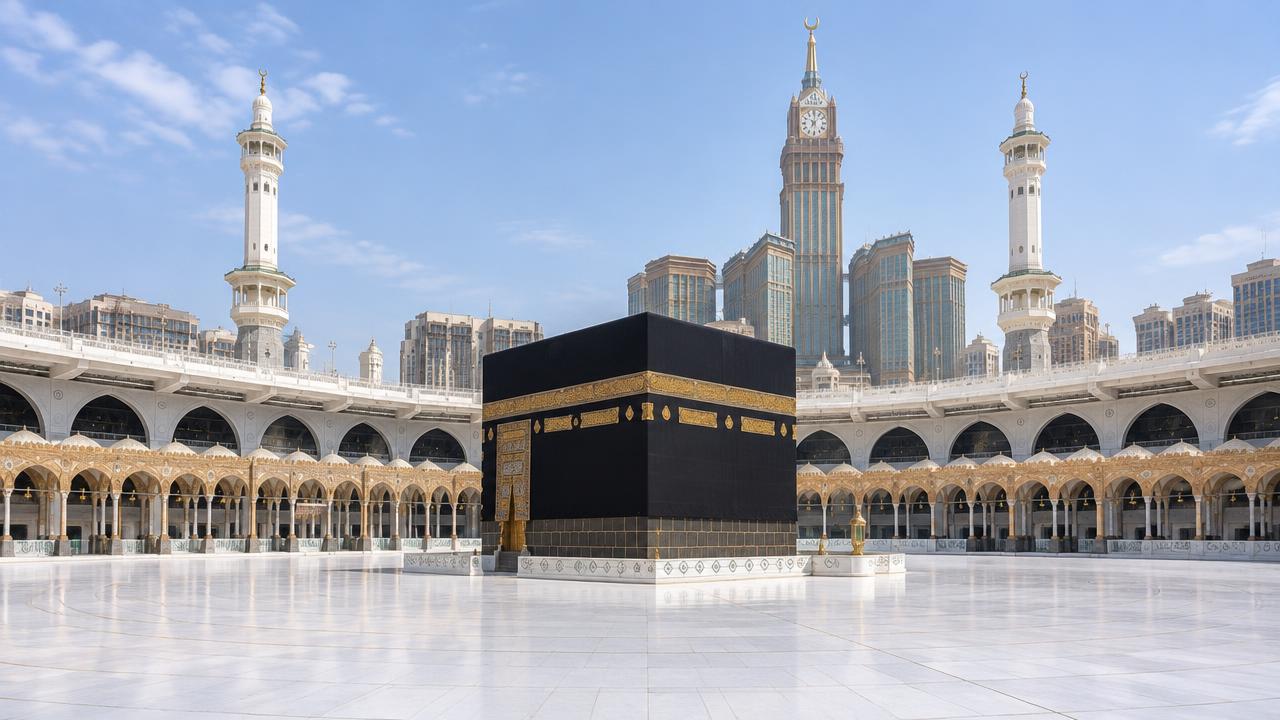
Lesson 12 · Tawaf: Shuroot and Sunnan
The conditions and sunnahs of tawaf, with guidance on purity, counting circuits and crowd safety.
Imam Sheikh Omar Effendi · 19 October 2026 · 76 min
In summary
Imam Sheikh Omar Effendi explains tawaf as worship, not merely walking around the Kaaba. He reviews its place among the five essentials of Umrah and stresses that an essential cannot be delegated or replaced by compensation. Tawaf requires covered awrah, ritual purity, seven complete anti-clockwise circuits beginning and ending at Hajar al-Aswad, passage outside the hatim, and the intention of worship. He discusses menstruation, renewing wudu, and Shafi'i–Hanafi differences concerning touch and purification. The sunnahs include istilam, meaningful du'a and adhkar, men's raml and shoulder exposure, and continuity without unnecessary delays. Throughout, he emphasises personal responsibility for completing each circuit and avoiding harm in crowded conditions.
Key takeaways
- 01Check your awrah covering and ritual purity before beginning tawaf, and promptly cover any accidental exposure.
- 02Complete seven anti-clockwise circuits outside the hatim, starting and finishing each at Hajar al-Aswad.
- 03Reach Hajar al-Aswad yourself before counting a circuit complete, even if your group leader has already moved ahead.
- 04If your wudu breaks, move aside, renew it and continue from where you stopped, as the teacher explained.
- 05A menstruating woman may enter ihram but must wait until menstruation ends and perform ghusl before tawaf.
- 06When adopting Hanafi guidance on accidental touch, follow its wudu requirements as explained rather than mixing rules casually.
- 07Use tawaf for focused Quran recitation, adhkar and du'a, including supplication in your own language.
- 08Men should observe the taught raml and shoulder-exposure practices for tawaf rukn without pushing or harming others.
- 09Avoid unnecessary delays, but rest when tired and then continue your tawaf.
Mentioned in this lesson
- Qur'an, Surah al-Ma'idah (Surah 5): washing the prescribed parts in wudu; verse number not given.
- Qur'an: prohibitions concerning marriage to fathers' and sons' wives; surah and verse numbers not given.
- Qur'an: “Qul in kuntum tuhibbun Allah fattabi'uni…” on following the Prophet and receiving Allah's love and forgiveness; surah and verse numbers not given.
- Qur'an: “Rabbana atina fid-dunya hasanah…” recited between Rukn Yamani and Hajar al-Aswad; surah and verse numbers not given.
- Qur'an, Surah al-Ahzab (Surah 33): cited by the teacher during his discussion of hijab and lowering the gaze; verse number not given.
- Hadith cited on Islam being a religion of tolerance and ease; collection and reference number not given.
- Reports cited about the Prophet moving Aisha's legs during prayer and his feet being touched, alongside his gratitude as Allah's servant; collections and reference numbers not given.
- Report describing Hajar al-Aswad as Allah's right hand, interpreted figuratively by the teacher; collection and reference number not given.
- Report of Umar saying he kissed Hajar al-Aswad because he had seen the Prophet kiss it; collection and reference number not given.
- Hadith of Abdullah ibn Umar on the Prophet touching Hajar al-Aswad and Rukn Yamani; collection and reference number not given.
- Report on raml after Hudaybiyyah, demonstrating strength following fever in Madinah; collection and reference number not given.
- Report of the Prophet praying before the Kaaba without a sutrah while people passed in front; narrator, collection and reference number not given.
- Reports involving Ibn Zuraij, Ibn Hisham and Ata on women performing tawaf alongside men, and Aisha keeping her distance; collection and reference numbers not given.
- Scholarly views of Imam Shafi'i, Imam Abu Hanifa, Imam Malik and Imam Ahmad ibn Hanbal on covering, purity and tawaf practices; specific works and reference numbers not given.
Something to reflect on
Could you complete and count your own circuits correctly without relying entirely on a group leader? How will you keep your tawaf focused on Allah while protecting others from harm?
Did you know?
- • Du'a during tawaf may be made in your own language.
- • A menstruating woman may enter ihram, but must wait before performing tawaf.
- • Resting when tired is allowed; tawaf can then be continued.
Test yourself
0/21Quiz
1. How does Imam Sheikh Omar Effendi describe tawaf?
2. How many complete circuits are required for tawaf?
3. In which direction should tawaf be performed?
4. Where does each circuit begin and end?
5. What should someone do if their awrah becomes accidentally exposed during tawaf?
6. What does the lesson teach about an essential of Umrah?
7. According to the teacher, what should you do if your wudu breaks during tawaf?
8. Your group leader has reached Hajar al-Aswad, but you have not. What should you do?
9. What guidance is given about adopting Hanafi guidance on accidental touch?
10. How should men observe the taught raml and shoulder-exposure practices for tawaf rukn?
True or false
Tawaf requires the intention of worship.
A menstruating woman may perform tawaf immediately after entering ihram.
Supplication during tawaf must not be made in your own language.
Passing through the hatim fulfils the requirement to go outside it.
Someone who becomes tired may rest and then continue tawaf.
Match-up
Tap a term, then its meaning.
Share this lesson
WhatsAppMore from Umrah 2026
- Lesson 15 · The Solaah of the Traveller (Musaafir): Qasr Solaah
Imam Sheikh Omar Effendi · 9 November 2026 · 56 min
- Lesson 14 · Tahallul; Tawaaful Widaa
Imam Sheikh Omar Effendi · 2 November 2026 · 64 min
- Lesson 13 · Sa'i: Procedure & Shuroot; Adaab of Drinking Zamzam
Imam Sheikh Omar Effendi · 26 October 2026 · 67 min
- Lesson 11 · Arriving in Makkah and Beginning Tawaf
Imam Sheikh Omar Effendi · 12 October 2026 · 72 min
- Lesson 10 · Preparing for Ihram: Miqat, Intention, Prayer and Talbiyah
Imam Sheikh Omar Effendi · 5 October 2026 · 61 min
- Lesson 9 · Umrah Preparation: Miqat Rules, Departure Etiquette and Travel Supplications
Imam Sheikh Omar Effendi · 21 September 2026 · 62 min
- Lesson 8 · Ihram: the Miqat (Demarcation of Place)
Imam Sheikh Omar Effendi · 14 September 2026 · 60 min
- Lesson 7 · Bab al-Umrah: Hajj, Umrah & the Arkan of Umrah
Imam Sheikh Omar Effendi · 7 September 2026 · 59 min
- Lesson 6 · Special Circumstances in Hajj/Umrah: Women in Iddah, Children & Badal
Imam Sheikh Omar Effendi · 31 August 2026 · 68 min
- Lesson 5 · Women: Travel Rulings & the Mahram
Imam Sheikh Omar Effendi · 17 August 2026 · 62 min
- Lesson 4 · Umrah and Concern for the Elderly
Imam Sheikh Omar Effendi · 10 August 2026 · 56 min
- Lesson 3 · The Shurut of Umrah/Hajj & Istita'ah
Imam Sheikh Omar Effendi · 3 August 2026 · 56 min
- Preparation for Umrah
Imam Sheikh Omar Effendi · 20 July 2026 · 54 min