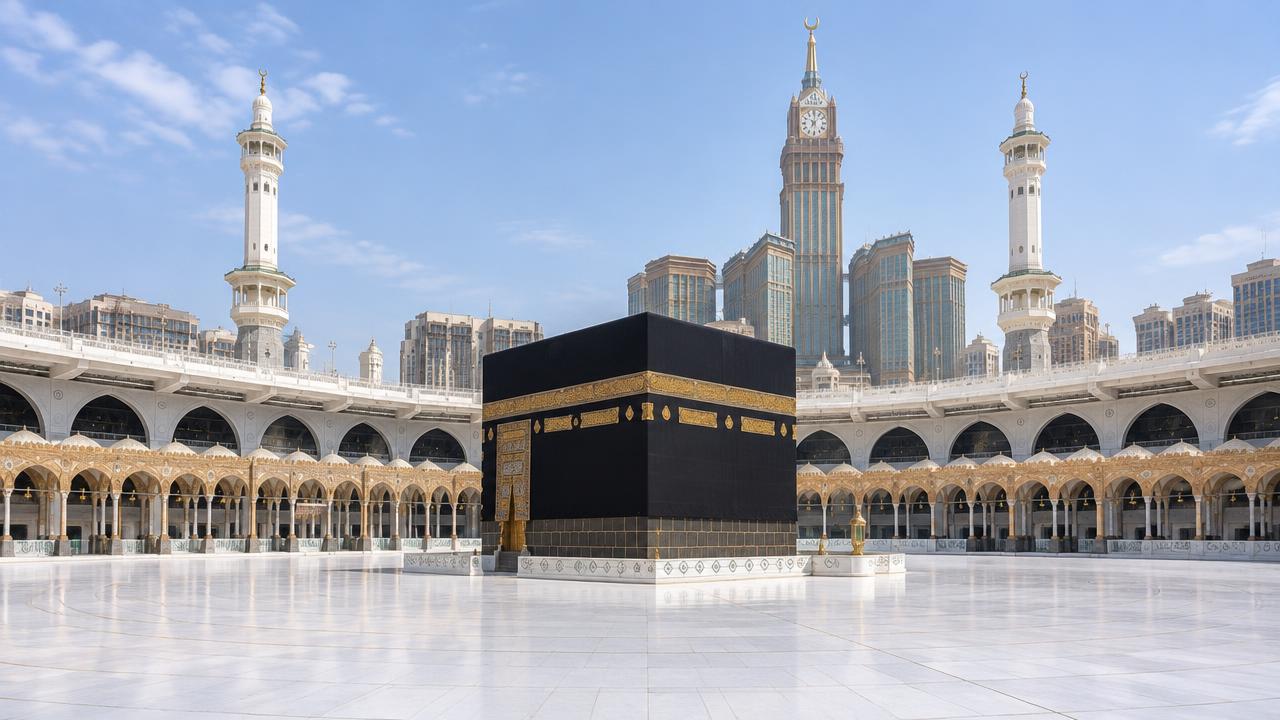
Lesson 11 · Arriving in Makkah and Beginning Tawaf
Arrival preparations, beginning tawaf, meaningful supplications and safe movement around the Kaaba.
Imam Sheikh Omar Effendi · 12 October 2026 · 72 min
In summary
The lesson moves from travel and arrival preparations to a walkthrough of tawaf’s first circuit. Sheikh Omar explains locating Hajar al-Aswad, following the counterclockwise route, passing outside the Hijr, and using supplication and dhikr meaningfully. He emphasizes crowd awareness and distinguishes suggested prayers from the ritual itself. A closing diagram reviews landmarks and prayer after tawaf. Legal classifications reflect the speaker’s presentation; no madhhab is explicitly identified. Chapter times are approximate navigation points within the supplied timestamp blocks.
Key takeaways
- 01Prepare for travel independently; transport changes do not remove the need to observe the miqat.
- 02Ihram is a ritual state: the speaker permits bathing without perfume and explains that menstruating pilgrims remain in ihram while awaiting purity for tawaf.
- 03Begin the seven circuits at Hajar al-Aswad, moving counterclockwise with the Kaaba on your left.
- 04Pass outside the Hijr Ismail; the speaker warns that cutting through it invalidates that circuit.
- 05Avoid crowding or stopping abruptly to greet Hajar al-Aswad; the speaker describes gesturing when access is difficult.
- 06Suggested circuit prayers are not mandatory scripts; use personal du'a, Qur'an, and dhikr with understanding.
- 07The speaker allows the two rak'ahs after tawaf elsewhere in the Haram when necessary; do not obstruct circulating pilgrims.
Mentioned in this lesson
- Qur'an: Surah al-Kahf, referenced in the discussion of Musa and al-Khidr.
- Qur'an: Surah Ya-Sin, mentioned as a possible recitation during tawaf.
- Hadith: “Actions are only by intentions,” quoted during the preparation recap.
- Report quoted about the Prophet stopping talbiyah upon greeting Hajar al-Aswad.
- Report attributed to Ibn Umar about the Prophet kissing Hajar al-Aswad.
- Report quoted about the Prophet touching Hajar al-Aswad with a stick while mounted.
- Hadith attributed to Abu Dharr concerning “Subhanallahi wa bihamdihi.”
- Hadith attributed to Samurah ibn Jundub concerning four beloved expressions of remembrance.
- Reports referenced concerning seven categories shaded on the Day of Judgment and the Prophet’s Hawd.
Something to reflect on
How can I keep my tawaf attentive and prayerful while protecting others from crowding and distinguishing essential actions from suggested supplications?
Did you know?
- • Tawaf consists of seven circuits beginning at Hajar al-Aswad.
- • Pilgrims move counterclockwise, keeping the Kaaba on their left.
- • Suggested circuit prayers are not mandatory scripts.
Test yourself
0/21Quiz
1. Where do the seven circuits of tawaf begin?
2. How many circuits make up tawaf?
3. Which direction should pilgrims move during tawaf?
4. What does Sheikh Omar permit when bathing in ihram?
5. What remains necessary even when transport arrangements change?
6. What does the speaker describe doing when access to Hajar al-Aswad is difficult?
7. According to the speaker, what happens if a pilgrim cuts through the Hijr during tawaf?
8. How should the suggested circuit prayers be understood?
9. According to the speaker, what should menstruating pilgrims do while awaiting purity for tawaf?
10. If praying near the tawaf route would obstruct pilgrims, what does the speaker allow?
True or false
Transport changes remove the need to observe the miqat.
The speaker permits bathing without perfume while in ihram.
Pilgrims should stop abruptly to greet Hajar al-Aswad.
Personal du'a, Qur'an, and dhikr may be used rather than fixed circuit prayers.
The notes explicitly identify a madhhab for the lesson's legal classifications.
Match-up
Tap a term, then its meaning.
Share this lesson
WhatsAppMore from Umrah 2026
- Lesson 15 · The Solaah of the Traveller (Musaafir): Qasr Solaah
Imam Sheikh Omar Effendi · 9 November 2026 · 56 min
- Lesson 14 · Tahallul; Tawaaful Widaa
Imam Sheikh Omar Effendi · 2 November 2026 · 64 min
- Lesson 13 · Sa'i: Procedure & Shuroot; Adaab of Drinking Zamzam
Imam Sheikh Omar Effendi · 26 October 2026 · 67 min
- Lesson 12 · Tawaf: Shuroot and Sunnan
Imam Sheikh Omar Effendi · 19 October 2026 · 76 min
- Lesson 10 · Preparing for Ihram: Miqat, Intention, Prayer and Talbiyah
Imam Sheikh Omar Effendi · 5 October 2026 · 61 min
- Lesson 9 · Umrah Preparation: Miqat Rules, Departure Etiquette and Travel Supplications
Imam Sheikh Omar Effendi · 21 September 2026 · 62 min
- Lesson 8 · Ihram: the Miqat (Demarcation of Place)
Imam Sheikh Omar Effendi · 14 September 2026 · 60 min
- Lesson 7 · Bab al-Umrah: Hajj, Umrah & the Arkan of Umrah
Imam Sheikh Omar Effendi · 7 September 2026 · 59 min
- Lesson 6 · Special Circumstances in Hajj/Umrah: Women in Iddah, Children & Badal
Imam Sheikh Omar Effendi · 31 August 2026 · 68 min
- Lesson 5 · Women: Travel Rulings & the Mahram
Imam Sheikh Omar Effendi · 17 August 2026 · 62 min
- Lesson 4 · Umrah and Concern for the Elderly
Imam Sheikh Omar Effendi · 10 August 2026 · 56 min
- Lesson 3 · The Shurut of Umrah/Hajj & Istita'ah
Imam Sheikh Omar Effendi · 3 August 2026 · 56 min
- Preparation for Umrah
Imam Sheikh Omar Effendi · 20 July 2026 · 54 min