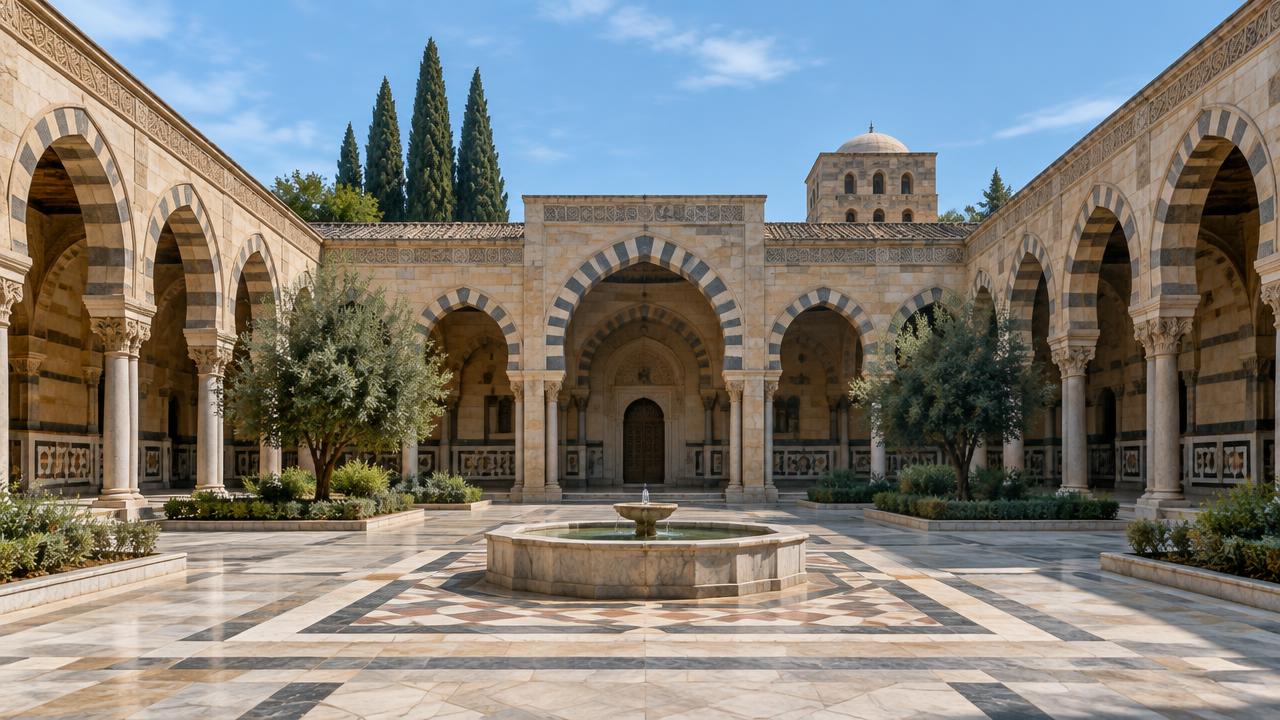
Lesson 51 · The Umayyad Dynasty
The caliphate of Muawiyah ibn Abu Sufyaan and the appointment of Yazid as his successor.
Imam Sheikh Omar Effendi · 16 September 2026 · 57 min
In summary
Lesson 51 of Islamic Civilization, delivered by Imam Sheikh Omar Effendi of Durbanville Islamic Society in Cape Town, examines the emergence of the Umayyad dynasty. Beginning with Mu'awiyah ibn Abu Sufyan (RA) and the establishment of Damascus as the centre of the khilafah after Hasan ibn Ali (RA), the lesson considers changes in government, diplomacy, security and naval organisation. The central turning point is Mu'awiyah’s (RA) decision to nominate his son Yazid as successor, which the lecturer presents as a shift towards hereditary rule. The closing discussion describes efforts to establish Yazid’s public standing through military command and leadership of Hajj. Throughout, the lecturer encourages respect for the Companions while acknowledging their human limitations and the need for caution when reading conflicting historical accounts.
Key takeaways
- 01Respect and historical examination belong together. The lecturer stresses that the Companions deserve honour, while their political decisions can still be discussed thoughtfully.
- 02Mu'awiyah ibn Abu Sufyan (RA) is introduced as a Companion and scribe of the Prophet Muhammad ﷺ. His sister, Umm Habibah (RA), was among the Prophet’s ﷺ wives.
- 03The lecturer contrasts the simpler public life of Madinah with the more elaborate court culture that developed in Syria. Restricted access to governors and separate prayer areas are presented as signs of increasing social distance between rulers and ordinary people.
- 04Diplomatic hospitality, banquets and exchanges of gifts are described as important features of Mu'awiyah’s (RA) statecraft. The lecturer connects these practices with stronger relationships and political stability.
- 05Official seals, guarded government premises and controlled access to rulers are discussed as security measures. The account of Umar ibn al-Khattab (RA) questioning Mu'awiyah (RA) highlights the tension between protecting authority and remaining accessible to the public.
- 06The lesson credits Mu'awiyah (RA) with strengthening the navy, patrolling maritime routes and securing trade. It also portrays his rule from Damascus as a period of considerable stability.
- 07The lecturer presents the nomination of Yazid as the most controversial decision of Mu'awiyah’s (RA) career: concern for continuity and avoiding renewed conflict became tied to keeping authority within his own family.
- 08Hereditary succession is the lesson’s key explanation for the emergence of a dynasty. The lecturer contrasts it with earlier approaches involving consultation, assessment of suitable leaders and the community’s acceptance.
- 09In the lecturer’s account, Yazid’s unsuccessful expedition towards Constantinople included the death and burial of Abu Ayyub al-Ansari (RA). Yazid was subsequently given leadership of Hajj for three years as part of efforts to establish his standing.
- 10The closing section reports that Abdullah ibn Umar (RA) and Abdullah ibn Abbas (RA) gave bay'ah to Yazid, which the lecturer connects with preserving peace. This is presented as the lecturer’s account, alongside his broader warning that reports about this period may contain conflicting or partisan material.
Mentioned in this lesson
- User-provided transcript of Islamic Civilization, Lesson 51: The Umayyad Dynasty, delivered by Imam Sheikh Omar Effendi of Durbanville Islamic Society in Cape Town, South Africa.
- Transcript PART markers at 0, 860, 1720 and 2580 seconds were used as chapter anchors. Intermediate chapter timestamps are approximate. No external historical sources were used.
Something to reflect on
How can we study difficult moments in Muslim history with both honesty and adab? Consider the lesson’s tensions between security and accessibility, stability and consultation, and family loyalty and responsibility to the wider ummah. What might these discussions teach us about leadership in our own communities?
Did you know?
- • Umm Habibah (RA), sister of Mu'awiyah (RA), was among the wives of Prophet Muhammad ﷺ.
- • The lesson describes official seals as a way to protect government affairs.
- • According to the lecturer, Yazid led Hajj for three years.
Test yourself
0/21Quiz
1. Which city became the centre of the khilafah under Mu'awiyah (RA)?
2. What service did Mu'awiyah (RA) perform for Prophet Muhammad ﷺ?
3. What does the lecturer encourage when studying the Companions' decisions?
4. Which practices were important features of Mu'awiyah's (RA) diplomacy?
5. What purpose did official seals and guarded government premises serve?
6. What benefit does the lesson associate with strengthening the navy?
7. What tension is highlighted by Umar ibn al-Khattab (RA) questioning Mu'awiyah (RA)?
8. Why is the nomination of Yazid presented as a turning point?
9. Why does the lecturer urge caution when reading accounts of this period?
10. In the lecturer's account, how were Yazid's military command and leadership of Hajj connected?
True or false
The lecturer contrasts Madinah's simpler public life with Syria's more elaborate court culture.
Restricted access to governors is presented as reducing the distance between rulers and ordinary people.
The lecturer describes Yazid's expedition towards Constantinople as successful.
The lesson contrasts hereditary succession with earlier approaches involving consultation and community acceptance.
The lecturer connects the reported bay'ah of Abdullah ibn Umar (RA) and Abdullah ibn Abbas (RA) to Yazid with preserving peace.
Match-up
Tap a term, then its meaning.
Share this lesson
WhatsAppMore from Islamic Civilization
- Lesson 57 · The Rise and Fall of Hajjaaj ibn Yusuf ath-Thaqafi
Imam Sheikh Omar Effendi · 11 November 2026 · 61 min
- Lesson 56 · The Appointment of Caliph Abdul Malik ibn Marwan; The Destroyer
Imam Sheikh Omar Effendi · 4 November 2026 · 56 min
- Lesson 55 · The Revolt of the Ummah & the Rise of Mukhtar al-Thaqafi
Imam Sheikh Omar Effendi · 28 October 2026 · 56 min
- Lesson 54 · The Death of Yazid
Imam Sheikh Omar Effendi · 21 October 2026 · 55 min
- Lesson 53 · The Caliphate of Yazid: Three Calamities
Imam Sheikh Omar Effendi · 14 October 2026 · 56 min
- Lesson 52 · The Caliphate of Yazid ibn Muawiyah
Imam Sheikh Omar Effendi · 7 October 2026 · 56 min